 Skip to content

Hurricane Blower: A Practical TTHM Compliance Tool for Municipal Water Systems

If your utility is dealing with a TTHM compliance notice — or fighting the same chloroform problem every season — you already know that the standard recommendation is an aeration system. What you may not know is that there is a more accessible option worth evaluating first.
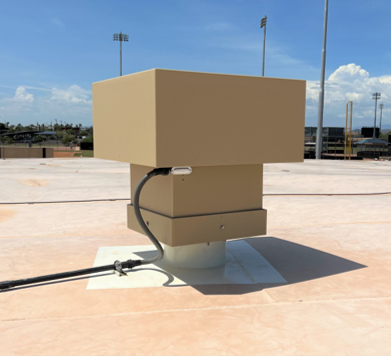
The Hurricane Blower is an active air ventilation system designed to reduce total trihalomethanes (TTHMs) in municipal water storage tanks and standpipes. It is not a replacement for every aeration scenario, and we will be straightforward about where it fits and where it does not. But for utilities facing chloroform-driven TTHM issues, it has demonstrated measurable results at a cost that makes a pilot project a reasonable first step.
How the Hurricane Blower Works
TTHMs form when disinfectants — typically chlorine or chloramines — react with naturally occurring organic matter in the water. In storage tanks and standpipes, the problem compounds: water sits longer, temperatures fluctuate, and the headspace above the waterline traps humidity while off-gassing conditions allow disinfection byproduct concentrations to build.
The Hurricane Blower addresses this by actively managing the tank headspace. Mounted near the center of the tank with perimeter mushroom vents distributing airflow, it forces continuous fresh air exchange across the water surface. This leverages Henry’s Law of Equilibrium — continuously evacuating the headspace lowers the partial pressure of volatile compounds, driving TTHMs to cross the diffusional barrier from liquid to gas and exit the tank.
The same mechanism that removes TTHMs also transforms the headspace environment for the steel structure above the waterline. By continuously introducing drier outside air, the Blower reduces the humidity, temperature, and chlorine fume concentration that drive corrosion — the three primary factors that make a tank headspace the most corrosive area in the entire distribution system.
The result is a system that addresses two costly and connected problems simultaneously: TTHM compliance and long-term tank asset deterioration.

Need help? Contact Us
The Combined System — How It Performs Best
The Hurricane Blower is most effective when paired with the Tidal Wave Mixer, our active water tank mixing system. Here is why that matters.
TTHMs are not uniformly distributed throughout a storage tank. Stratification — the layering of water at different temperatures — concentrates byproducts in specific zones and limits the rate at which ventilation can work. The Tidal Wave Mixer eliminates that stratification, circulating the full water column and continuously presenting water to the ventilated surface.
When both systems operate together, utilities have seen 20–25% reductions in chloroform concentrations — the most common TTHM driver in drinking water systems. The Blower handles the headspace. The Mixer handles the water column. They are designed to work as a team.
Tank Corrosion — The Problem Nobody Is Measuring
The headspace above the waterline in a steel drinking water tank is the most corrosive environment in your entire distribution system. High chlorine fumes, elevated humidity, and heat combine to attack internal roof surfaces continuously — accelerating coating failure, exposing bare steel, and quietly advancing the timeline on a tank repaint or structural repair that can run well into six figures.
Most utilities do not measure headspace corrosion rates. They are discovering the damage during inspection cycles or when a coating failure forces an unplanned intervention.
The Hurricane Blower directly addresses the three environmental factors driving headspace corrosion. By continuously introducing drier outside air, it reduces humidity, lowers air temperature, and dilutes the chlorine fume concentration above the waterline. The result is a fundamentally less corrosive environment for the tank structure — a benefit that is independent of whether TTHM reduction is the primary goal.
For the first time, that corrosion reduction was independently measured and documented in the Peoria pilot study.

The Cost Reality
A traditional forced-air aeration system for TTHM mitigation typically runs in the six to seven-figure range in capital cost — before installation, site work, and ongoing maintenance are factored in. For many utilities, especially smaller systems already operating lean, that number ends the conversation before it starts.
The Hurricane Blower is priced to make a pilot project feasible for most municipal budgets — a meaningful difference when you are not yet certain whether aeration is the right long-term solution for your system.
For utilities that have not yet confirmed the source of their TTHM problem, that cost difference means you can gather real compliance data on your specific system without committing to infrastructure-level capital expenditure upfront.
What It Will and Won't Do
We want operators and engineers to have accurate expectations before they pick up the phone.
Where it performs: The Hurricane Blower has demonstrated meaningful results in systems where chloroform is the primary disinfection byproduct driving TTHM exceedances. Combined with the Tidal Wave Mixer, reductions of 20–25% in chloroform concentrations have been documented.
Where results are less predictable: Results vary by system. Factors including tank geometry, water age, source water chemistry, and disinfection approach all influence outcomes. We do not offer guaranteed results, and we will tell you that directly. We can help you assess whether your system profile fits the application before you commit.
Where it is limited: If bromoform — not chloroform — is your primary DBP driver, the Hurricane Blower is unlikely to produce significant TTHM reductions. Bromoform behaves differently in the water column and does not respond to headspace ventilation in the same way. If you are unsure which compound is driving your exceedance, your water quality data will tell you — and we are happy to help you read it.
Corrosion reduction: The Hurricane Blower reliably reduces tank headspace corrosion by eliminating excess humidity and lowering air temperature above the waterline. The Peoria pilot documented corrosion rates 13 to 25 times lower in the treated tank compared to the untreated control, with headspace humidity running 20% lower. For systems where internal corrosion is a maintenance burden, this benefit is measurable and independent of TTHM profile.
Site requirements: Power must be pulled to the blower control panel. A penetration is required in the tank. An access hatch must be installed for the blower to mount to.
Technical Specifications
| Specification | Detail |
|---|---|
| Weight | 225 lbs |
| Airflow Capacity | Up to 3,740 CFM |
| Power Requirement | 120V, 20A circuit, single phase |
| Sound Level | 70 dB at 10 ft |
| Drive System | Direct drive - no belts |
| Construction | High-Density Polyethylene (HDPE) exterior |
| Typical Installation Time | 3 hours |
| Preventative Maintenance | None required; filter replacement as neded |
| Motor Service | Run-to-fail design |
| Warranty | 1 year |
Frequently Asked Questions
Is the Hurricane Blower effective for all TTHM problems?
No. It performs best in systems where chloroform is the primary disinfection byproduct driving TTHM exceedances. If bromoform is your primary DBP, this system is unlikely to be the right solution. If you are unsure what is driving your numbers, we recommend pulling your DBP speciation data before making any equipment decision. We can help you work through it.
What does installation require?
Power to the control panel, a tank penetration, and a mounting hatch. A recent installation was completed in three hours. No tank draining or service interruption is required for mixer installation; the Blower's tank access requirements should be reviewed on a site-specific basis.
Is there ongoing maintenance?
No scheduled preventative maintenance. Replace filters as needed. The motor is a run-to-fail design, which simplifies operations for understaffed utilities.
Do we need the Tidal Wave Mixer, or does the Blower work on its own?
The Blower can operate independently, but optimal results — including the 20–25% chloroform reductions we have documented — are achieved with the combined system. The Mixer eliminates stratification that limits the Blower's effectiveness, and the two are designed to work together.
How loud is it?
70 dB measured at 10 feet — roughly equivalent to a conversation at close range or background restaurant noise. It is not silent, but it is not disruptive to normal operations.
What size systems is it appropriate for?
The Hurricane Blower has been applied across a range of municipal system sizes. Fit depends more on the DBP profile and tank configuration than on system size. Contact us to discuss your specific situation.
Case Study — Sports Complex, Peoria, AZ
The City of Peoria, serving 191,000 residents, faced recurring TTHM compliance challenges during Q2 and Q3 — hot summer temperatures combined with a high percentage of surface water in their blend pushed TTHM levels toward and above the 80 PPB regulatory limit.
D&H Water Systems proposed a proof-of-concept pilot at the Sports Complex R103 site, which had two 1-million-gallon tanks operating in tandem — an ideal setup for a controlled side-by-side comparison. Tank 2 received the Tidal Wave Mixer and Hurricane Blower system. Tank 1 served as the untreated baseline. Independent certified lab sampling was conducted over a four-week period.
TTHM Results: Over three weeks of concurrent operation, Tank 2 averaged 23% lower TTHM concentrations than the untreated Tank 1. When the mixer was taken offline briefly and then restarted, Tank 2 showed a 32.6% TTHM reduction within one week of the system coming back online — underscoring how quickly the combined system responds.
Corrosion Results: Corrosion rate monitoring, conducted independently, recorded rates 13 to 25 times higher in the untreated tank. Headspace humidity was 20% higher in the control tank. Air temperature ran 5 to 10 degrees higher. The combined effect on above-water steel surfaces was dramatic and measurable.
The study authors concluded that the combined system successfully achieved the TTHM reduction objective while simultaneously producing a demonstrably cooler, drier, and less corrosive headspace environment — extending asset longevity alongside improving water quality compliance.
Not Sure If the Hurricane Blower Fits Your Situation?
Most of the conversations we have start the same way — a utility is under pressure, short on staff, and seeking clarity on whether there is a realistic path forward without a major capital project.
That is exactly what we are here to help you work through. Tell us what you are dealing with, and we will give you a straight answer, including whether we believe this is the right fit.
Our Other Helpful Products:
Active Water Tank Mixer
Our enhanced ability to reduce trihalomethanes in drinking water is due to the active water reservoir mixer, the Tidal Wave Mixer, working with the Hurricane Blower as a team. The water reservoir mixer excites all the water in the reservoir, increasing the rate at which the Hurricane Blower can remove trihalomethanes from the drinking water
Struggling to Maintain Chloramine Residual?
Our Chloramine Booster Systems (CBS) are flexible, precise, and dependably built to maintain consistent total chlorine residual in drinking water reservoirs, standpipes, and distribution systems. Gone are the days of hand-carrying chemicals up the ladder! Learn more…

